Key takeaways
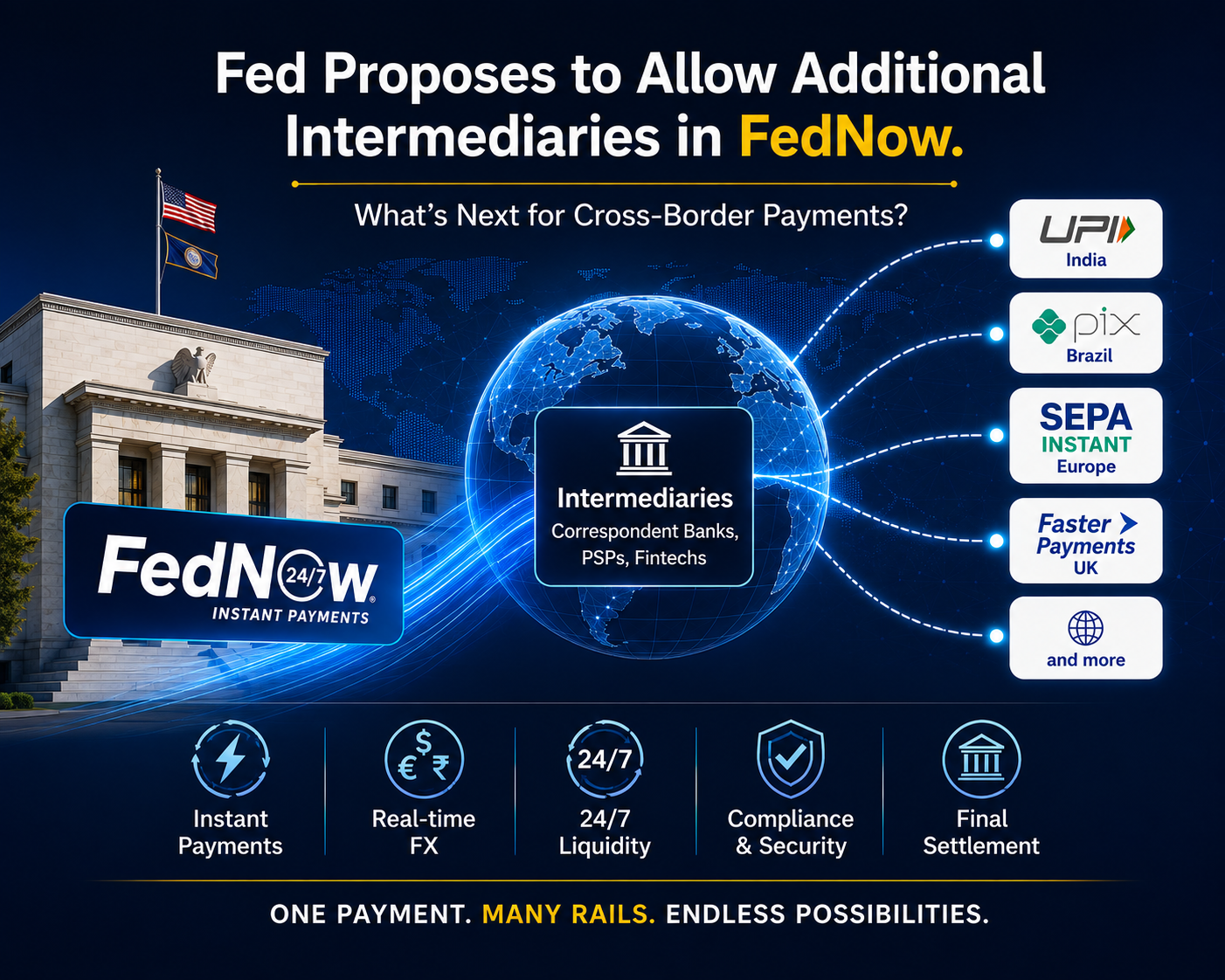
- The Federal Reserve is proposing to allow FedNow participants to use additional intermediaries, including correspondent banks, for the international portion of a transaction.
- The proposal does not turn FedNow into a global payment rail; it creates greater flexibility for FedNow to participate in cross-border payment arrangements.
- The next phase of global payments is likely to focus on interoperability between domestic instant-payment systems such as FedNow, UPI, Pix, SEPA Instant and Faster Payments.
- Real-time FX, 24/7 liquidity, compliance, settlement and reconciliation will be as important as the payment rail itself.
The global payments industry is approaching an important inflection point.
For more than a decade, financial institutions, central banks and payment companies have invested heavily in making domestic payments faster, more accessible and increasingly available around the clock.
The results are visible across major markets. India has UPI. Brazil has Pix. Europe has SEPA Instant. The United Kingdom has Faster Payments. The United States has FedNow and the RTP Network.
Domestic instant payments are no longer an experiment. They are becoming core financial infrastructure.
The next challenge is considerably more complex:
How do we connect these domestic instant-payment systems across borders?
The Fed’s proposal: a small regulatory change with a larger implication
In April 2026, the Federal Reserve Board proposed amendments to Regulation J that would allow participants in the FedNow Service to use intermediaries other than Federal Reserve Banks to send funds transfers through FedNow.
The proposal specifically contemplates allowing a FedNow participant to use an intermediary, such as a correspondent bank, for the international portion of a cross-border transaction while FedNow is used for the U.S. domestic portion.
This is an important distinction.
The proposal does not make FedNow a global payment system. It does not create a direct FedNow-to-foreign-payment-system connection.
Instead, it creates greater flexibility for regulated intermediaries to participate in the payment chain. That may ultimately prove to be the more important development.
The question, therefore, is not simply what the Fed has proposed.
The bigger question is: What comes next?
The world is moving towards interoperability
The emerging global model is increasingly clear. Countries are not necessarily looking to replace their domestic payment infrastructure with a single global system. Instead, they are exploring ways to connect existing domestic instant-payment systems.
The future may not be one global payment rail. It may be many domestic rails, connected through interoperable infrastructure.
Europe provides a strong example. The Eurosystem is working towards cross-border payment capabilities between TIPS and other fast-payment systems and is implementing the interlinking of TIPS with India’s UPI, while also exploring connections with the BIS-led Nexus Global Payments initiative.
This is more than a technology project. It represents a different architecture for global payments.
FedNow could become one building block
Under the proposed framework, a U.S. financial institution could potentially use FedNow to settle the domestic U.S. leg of a transaction while relying on an intermediary for the international leg.
The structure could therefore look broadly like:
U.S. sender → FedNow → intermediary → international payment infrastructure → beneficiary
The customer sees one payment. Behind the scenes, several payment systems and financial institutions may be involved.
This is not necessarily a weakness. It may be the practical model through which domestic payment systems become globally connected.
The objective should not be to eliminate every intermediary. The objective should be to eliminate unnecessary friction, delay and manual intervention.
The correspondent bank is evolving, not disappearing
For several years, technology discussions have suggested that instant payments, fintechs and new settlement technologies could eventually eliminate correspondent banking.
The FedNow proposal points towards a different possibility.
Correspondent banks may remain important, but their role could change.
The traditional correspondent model involved accounts, messages, cut-off times, manual processes and multiple reconciliation points. The emerging model could be much more automated.
A correspondent or other intermediary could provide:
- International connectivity
- FX execution
- Liquidity
- Compliance and screening
- Settlement
- Reconciliation
through APIs and automated processes.
The intermediary becomes less of a processing bottleneck and more of a real-time financial infrastructure provider.
Instant payments do not automatically create instant cross-border payments
There is an important distinction that the industry must recognise.
Instant domestic payment is not the same as instant cross-border payment.
A domestic instant payment may settle within seconds. A cross-border transaction introduces several additional layers:
- FX conversion
- Liquidity
- AML and sanctions screening
- Fraud and scam controls
- Beneficiary validation
- Regulatory reporting
- Settlement
- Reconciliation
- Dispute and exception management
Connecting payment rails addresses only one part of the problem. For a cross-border payment to become genuinely real-time, the supporting financial infrastructure must operate at the same speed.
FX may become the next bottleneck
This is where the conversation needs to move from payment technology to treasury infrastructure.
Consider a simple USD-to-INR transaction. The U.S. payment leg may be completed in seconds. But the beneficiary ultimately needs INR.
Someone must provide the FX rate. Someone must provide INR liquidity. Someone must take or hedge the currency position. Someone must settle the transaction. Someone must manage the corresponding nostro or settlement account. Someone must reconcile the transaction.
If these processes continue to operate during traditional banking hours or through batch processes, the payment may be instant but the cross-border transaction is not.
This is why the next phase of payment innovation must bring together:
Instant payments + real-time FX + 24/7 liquidity + real-time compliance + settlement + reconciliation.
This is where treasury becomes a critical component of the instant-payment ecosystem.
24/7 payments require 24/7 treasury
The move towards instant cross-border payments will fundamentally change treasury operations.
A customer does not distinguish between Monday morning and Sunday night. If a payment system is available 24/7, customers increasingly expect the supporting financial services to be available 24/7 as well.
This creates new requirements for financial institutions:
- Real-time liquidity visibility
- Automated FX pricing
- Automated hedging and position management
- Multi-currency funding
- Real-time nostro monitoring
- Intraday and overnight liquidity management
- Automated reconciliation
- Real-time risk controls
The payment rail may be the visible part of the transformation. But the treasury infrastructure underneath it may determine whether the model actually works.
ISO 20022: connecting data as well as money
Interoperability is not simply about connecting networks. The systems also need to understand each other’s data.
ISO 20022 has an important role to play here. Structured and richer payment information can enable greater automation across the transaction lifecycle.
The same data can support:
Payment processing → Screening → Compliance → FX → Settlement → Reconciliation → Reporting
The objective should therefore be more than sending a payment message faster. It should be to make the entire payment straight-through, machine-readable and capable of automated decision-making.
India and UPI: a critical part of the emerging architecture
For India, this global transition is particularly significant.
UPI has already demonstrated that a domestic instant-payment system can operate at extraordinary scale. The next opportunity is international interoperability.
The Eurosystem’s work towards connecting TIPS with India’s UPI is particularly important. Project Nexus represents another important development, seeking to provide a common approach for connecting multiple domestic instant-payment systems.
For India, this creates an opportunity to move from being a global leader in domestic instant payments to becoming an important participant in the emerging architecture of global instant payments.
BRICS adds another dimension
The discussion is also moving into multilateral forums. Recent BRICS discussions have included potential linkages between fast-payment systems and central bank digital currencies as part of broader efforts to improve cross-border payments and reduce transaction costs.
These discussions remain at an early stage. Nevertheless, they demonstrate that cross-border payment interoperability is no longer only a technology-industry conversation.
It is increasingly becoming a question of financial infrastructure, monetary policy, regulatory cooperation, economic sovereignty, trade and investment.
What should happen next?
The FedNow proposal is an important regulatory step. But regulatory permission alone will not create instant cross-border payments.
The next phase will require coordinated development across several layers.
1. Interoperable payment infrastructure
Domestic instant-payment systems need standardised mechanisms for connecting with other jurisdictions.
2. Real-time FX infrastructure
Cross-border instant payments require FX markets capable of providing competitive pricing and execution beyond traditional market hours.
3. 24/7 liquidity infrastructure
Banks and payment providers need access to multi-currency liquidity whenever customers initiate payments.
4. Real-time compliance
AML, sanctions, fraud and beneficiary screening need to operate without creating a new manual bottleneck.
5. Common data standards
ISO 20022 can provide an important foundation, but harmonisation of implementation is equally important.
6. Regulatory coordination
Central banks, regulators, payment-system operators and financial institutions will need common frameworks for governance, liability, settlement finality, data and consumer protection.
7. Corridor-based implementation
The industry should consider starting with high-volume corridors where there is strong trade, remittance and financial connectivity. This would allow regulators and market participants to test the operating model before expanding it across multiple jurisdictions.
The next competitive advantage
The first phase of payment innovation was about digitisation.
The second phase was about speed.
The next phase will be about interoperability.
The institutions that benefit most will not necessarily be those connected to the largest number of payment rails. They will be those capable of orchestrating the entire transaction.
Payment → FX → Liquidity → Compliance → Settlement → Reconciliation
All of these components need to work together.
That is the real challenge. And that is where banks, payment companies and fintechs will need to invest.
One global rail or many connected rails?
The global payments industry does not necessarily need one payment system to replace every other system. There are strong reasons for domestic systems to remain within national regulatory and financial frameworks.
The more practical model may be one where:
FedNow serves the U.S. domestic instant-payment ecosystem.
UPI serves India’s domestic ecosystem.
Pix serves Brazil.
SEPA Instant serves Europe.
Faster Payments serves the UK.
And regulated intermediaries and common standards connect them.
This approach could preserve domestic financial infrastructure while significantly reducing the friction associated with cross-border payments.
The real test
The success of this model should not be measured simply by whether a payment message reaches another country within seconds.
The real test is whether the entire transaction can be completed in real time.
Can the payment be initiated instantly?
Can FX be priced instantly?
Can liquidity be provided instantly?
Can compliance be completed instantly?
Can settlement be final?
Can the transaction be reconciled automatically?
Can the customer receive transparent pricing and status?
If the answer to all of these is yes, then we can legitimately begin to talk about real-time cross-border payments.
Conclusion: The architecture is changing
The Federal Reserve’s proposal to permit additional intermediaries in FedNow may appear narrow in regulatory terms.
Its potential significance is much broader.
It could help create a bridge between the U.S. instant-payment ecosystem and the wider global payments infrastructure.
At the same time, developments around UPI, TIPS, Project Nexus, Pix and other instant-payment systems are demonstrating that the world is moving towards a more interconnected payment environment.
The future is unlikely to be one global payment rail.
It is more likely to be a network of interoperable domestic and regional payment rails, supported by real-time FX, 24/7 liquidity, common data standards and coordinated regulation.
The customer should not need to understand any of this complexity.
The experience should be simple:
Send. Receive. Done.
The infrastructure behind that experience, however, will be considerably more sophisticated.
The question for the global financial industry is therefore no longer:
Can we make payments instant?
We already can.
The next question is:
Can we make cross-border money movement truly interoperable, 24/7 and end-to-end real time?
That is the next chapter of global payments.